You are on a flight and the engine drone fills the cabin. You tap your earbuds, and the noise does not simply vanish — it is measured, predicted and cancelled continuously. That trick used to be a fixed curve drawn in a laboratory. On the best 2026 headphones it is a live decision, and the marketing calls all of it AI.
The engineering splits it into two genuinely different things, and the difference decides which headset is worth your money. Here is how adaptive noise cancellation actually works, which 2026 models do it best, and what the microphone numbers really mean.
Quick Answer
Yes — the 2026 flagship headphones and earbuds from Sony, Bose, Apple and Samsung all adjust noise cancellation automatically, but they do it in two genuinely different ways. Sony and Bose use dedicated audio processors and microphone arrays to measure your fit and your surroundings and re-tune the anti-noise signal many times a second; Apple and Samsung brand the same behaviour as AI, with Apple blending noise cancellation and transparency into a single adaptive mode and Samsung using an AI-boosted algorithm that reads inner and outer microphones in real time.
The short version: if you want the strongest automatic adaptation in an over-ear design, the Sony WH-1000XM6 (12 microphones, HD Noise Canceling Processor QN3) and the Bose QuietComfort Ultra (CustomTune ear calibration, 8 microphones) are the two to compare. If you prefer in-ear, the Apple AirPods Pro and Samsung Galaxy Buds3 Pro both adapt automatically, but only inside their own ecosystems.
- Over-ear pick: Sony WH-1000XM6 — adaptive 12-microphone system, QN3 processor.
- Calibrated pick: Bose QuietComfort Ultra — CustomTune measures your ear shape.
- In-ear pick: Apple AirPods Pro (Adaptive Audio) or Samsung Galaxy Buds3 Pro (Galaxy AI).
- What to check before buying: microphone count, whether adaptation is automatic or mode-based, and which phone you own.
What “AI noise cancellation” actually means
The phrase AI noise cancelling headphones covers two different engineering approaches that get bundled under one label, and it is worth separating them before you compare products.
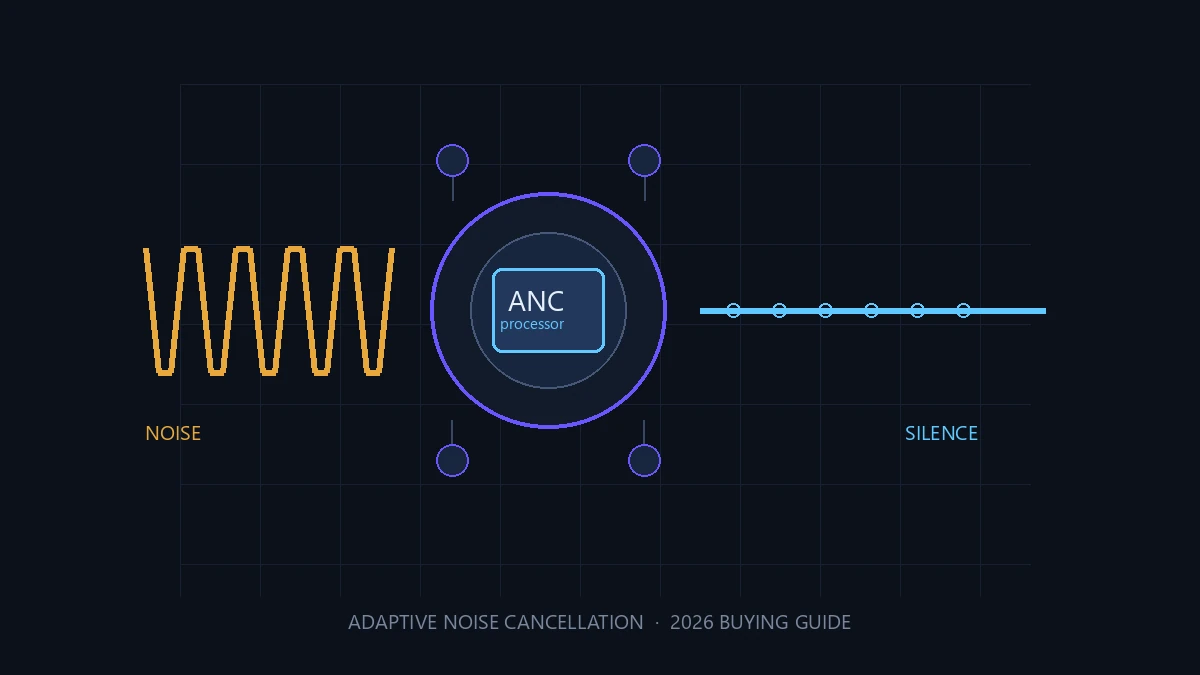
Adaptive signal processing is the older and more honest description. A noise-cancelling headset samples outside sound with feedforward microphones, samples what is actually reaching your eardrum with feedback microphones, and continuously adjusts the anti-noise signal it generates. That loop has existed for years. What changed by 2026 is the amount of computation behind it: faster dedicated processors and more microphones let the system re-optimise far more often, and factor in things like air pressure, the fit of the earpad, and whether you are wearing glasses or a hat.
Machine-learning classification is the newer layer, and it is where vendors legitimately use the term AI. Instead of treating all sound as noise to be cancelled, the system classifies what it hears — a voice, a siren, a passing train, wind — and decides how much of it you should still hear. Samsung describes its Galaxy Buds3 Pro as using an “AI-boosted algorithm” that analyses sound picked up by inner and outer microphones in real time and adjusts to your ear shape and wearing habits. Bose describes an “AI algorithm” layered over its CustomTune calibration for the Aware Mode in its second-generation QuietComfort Ultra Earbuds, and an “AI-powered noise suppression system” for calls.
Sony is the interesting case. Its official materials for the WH-1000XM6 talk about the HD Noise Canceling Processor QN3 and an “Adaptive NC Optimizer” rather than marketing the feature as AI, even though the underlying work is the same class of real-time optimisation. That is worth knowing when you compare products: the label on the box is not a reliable guide to how adaptive a system actually is.
How adaptive noise cancellation works
Every modern adaptive system is doing four jobs, whether or not the vendor calls them AI.
- Measure the outside. Feedforward microphones on the outside of the earcup or earbud capture incoming sound before it reaches you.
- Measure the result. Feedback microphones inside capture what is left, so the system knows how much leakage and fit loss there is.
- Classify the sound. Decide what is steady background (engine hum, air conditioning), what is intermittent (a siren, a announcement), and what is speech.
- Adjust the anti-noise. Recompute the cancellation signal, and in some designs blend in transparency so important sounds still reach you.
Two numbers tell you most of what you need to know about how capable that loop is. The first is microphone count — more microphones give the system more spatial information to work with. The second is the processor — the dedicated chip that runs the loop, and how quickly it can redo the calculation.
This is also why fit matters so much. A system that can measure the seal can compensate for a poor one; a system that cannot will simply cancel less. Bose’s CustomTune is the clearest example of this: it plays a short calibration chime when you put the headphones on, measures how the shape of your ear changes that chime, and uses the result to tune both sound and noise cancellation to you. The same loop runs in earbud form on Apple and Samsung devices — our guide to how AI earbuds adapt sound using on-device AI walks through the architecture in more detail, and our explainer on what AI noise cancellation in earbuds actually is covers the fundamentals if you are new to the term.
The 2026 line-up at a glance
| Device | Type | Adaptive technology | Microphones | Battery (ANC on) | Price (USD) |
|---|---|---|---|---|---|
| Sony WH-1000XM6 | Over-ear | HD Noise Canceling Processor QN3, Adaptive NC Optimizer | 12 | Up to 30 hours | $459.99 MSRP |
| Bose QuietComfort Ultra | Over-ear | CustomTune calibration, Aware Mode with ActiveSense | 8 | Up to 24 hours | $429.00 |
| Apple AirPods Pro 3 | In-ear | Adaptive Audio, Adaptive Transparency, Adaptive EQ | 3 per bud | Up to 6 hours (30 with case) | See Apple |
| Samsung Galaxy Buds3 Pro | In-ear | Galaxy AI Adaptive EQ / Adaptive ANC | 6 | Up to 6 hours (26 with case) | See Samsung |
Source notes: Sony’s figures are from its WH-1000XM6 product page and support documentation — the QN3 processor is stated as 7× faster than the QN1 in the WH-1000XM5, and Sony’s noise-cancellation claim is based on research by Sony Corporation measured using IEC-compliant guidelines across the top ten headband-style wireless noise-cancelling headphone brands by market share. Bose’s 8-microphone figure and 24-hour battery are from its QuietComfort Ultra product page. Apple’s battery and sensor figures are from its AirPods Pro 2 tech-spec page. Samsung’s microphone count and adaptive behaviour are from its Galaxy AI support page for the Buds3 Pro. Prices are manufacturer list prices at the time of writing; street prices, offers and regional taxes vary.
Sony WH-1000XM6: QN3 and 12 microphones
The WH-1000XM6 is Sony’s current flagship over-ear, and its noise-cancelling hardware is the most densely specified of the group. Sony pairs the new HD Noise Canceling Processor QN3 — which it states is 7× faster than the QN1 found in the WH-1000XM5 — with an adaptive 12-microphone system that the company says optimises noise cancellation, sound quality and call clarity in real time.
The feature that matters for this question is the Adaptive NC Optimizer. Sony’s support documentation describes it as measuring the headset’s wearing condition and usage environment to constantly optimise noise-cancelling characteristics. In practice that means it accounts for things that change through the day: how the earpads are seated, whether you have added glasses or a hat, and the air pressure around you. Sony’s specification page lists both an Adaptive NC Optimizer and atmospheric pressure optimising as supported, along with automatic ambient sound control.
Two practical points. First, Sony markets this as adaptive processing rather than AI, so if you are comparing spec sheets you will not find the word “AI” doing the work — the behaviour is what matters. Second, the automatic ambient sound feature means the headset can raise and lower the amount of outside sound it lets through without you touching a control, which is the behaviour most people actually mean when they ask whether a headset “uses AI”.
Bose QuietComfort Ultra: CustomTune and ActiveSense
Bose takes a different route, and in one respect it is the most transparent about what is happening. Its CustomTune calibration plays a short chime through the headphones when you put them on and measures how the unique shape of your ear and ear canal modifies that sound. The headphones then use that measurement to adjust both the audio you hear and the noise cancellation, and they keep adjusting as the environment around you changes.
The QuietComfort Ultra Headphones use what Bose describes as a comprehensive system of 8 microphones for advanced feedback and adaptive feed-forward noise reduction, with up to 24 hours of playback. The Quiet and Aware modes map onto the two ends of the scale — full cancellation, or a transparency that Bose says feels as if you are not wearing headphones at all.
Where Bose uses the term AI most directly is in listening modes that react to sudden sounds. Its Aware Mode uses ActiveSense to dampen unexpected loud noises without drowning out your content, and the second-generation QuietComfort Ultra Earbuds add what Bose calls an AI algorithm layered over CustomTune so that changes in cancellation level are smoother when the environment shifts. For calls, Bose describes an AI-powered noise suppression system that combines multiple microphones, dynamic mixing and adaptive filters to keep your voice clear.
Apple AirPods Pro: Adaptive Audio on a headphone chip
Apple’s approach is the simplest to describe and the most tied to its own ecosystem. AirPods Pro models with the H-series headphone chip — currently the AirPods Pro 3, and also the AirPods Pro 2 — offer an Adaptive listening mode that blends Active Noise Cancellation and Transparency together. Apple’s support documentation describes it as controlling how much noise you hear based on the changing noise conditions in your environment, and it can be dialled to allow more or less ambient sound.
Apple’s tech-specification page for the AirPods Pro 2 lists the sensors that make this possible: dual beamforming microphones, an inward-facing microphone, a motion-detecting accelerometer and a speech-detecting accelerometer, alongside the H2 headphone chip. Adaptive Transparency and Adaptive EQ are both listed as supported audio technologies. The same support page notes that Adaptive Audio, Personalized Volume and Conversation Awareness respond to your environment automatically, and that the settings carry over when your AirPods switch devices.
Battery and fit are the practical constraints. Apple rates the AirPods Pro 2 at up to 6 hours of listening on a single charge and up to 30 hours with the MagSafe Charging Case. And because the adaptive features are driven by Apple’s own chip and software stack, they work as described with an iPhone, iPad or Mac rather than as a cross-platform feature.
Samsung Galaxy Buds3 Pro: Galaxy AI adaptive ANC
Samsung is the most explicit of the four about calling the feature AI. For the Galaxy Buds3 Pro, Samsung’s own support material describes Galaxy AI-assisted Adaptive EQ and Adaptive ANC that uses an AI-boosted algorithm to analyse sound detected through the inner and outer microphones in real time, then adjusts the sound to conform to your fit with what Samsung calls pinpoint precision. It says the system is based on individual ear shape and wearing habits.
The Buds3 Pro carries 6 microphones, and Samsung lists both Adaptive Noise Control and Active Noise Cancellation as supported, along with Adaptive EQ. The practical behaviour Samsung describes is the classification layer in action: its support page says the automatic noise adjustment tailors the sound to your surroundings, switching to a more ambient setting when it detects a siren and adjusting towards active noise cancellation for construction-type noise.
As with Apple, the adaptive layer is deepest inside its own ecosystem. Samsung notes that Galaxy AI features on the Buds3 Pro are automatically enabled after pairing with a Samsung device, and that some features may only be available on select Samsung devices.
What the microphone and battery numbers mean
Microphone count is the most commonly quoted figure and the most easily misread. More microphones mean more spatial information and better call quality, but the number alone does not tell you how often the system recomputes, or how well it classifies what it hears. Sony’s 12 microphones are paired with a processor it says is 7× faster than the previous generation; Samsung’s 6 microphones are paired with an AI-boosted algorithm that reads inner and outer mics together. Both designs are doing the same job with different hardware budgets.
Battery figures also need care. The numbers in the table are vendor ratings with noise cancellation switched on, measured under each manufacturer’s own conditions. Real-world figures will be lower with higher volume, with adaptive features running constantly, and with additional sensors active. Apple rates the AirPods Pro 2 at up to 6 hours per charge, which is the lowest of the group on a like-for-like single-charge basis, but its case brings the total to 30 hours.
Does AI noise cancellation cost more?
It does, because the hardware that makes it work is not cheap. The two over-ear flagships in this guide list at $459.99 USD (Sony WH-1000XM6, MSRP) and $429.00 USD (Bose QuietComfort Ultra). Both sit at the top of their respective ranges, and the adaptive processing hardware is part of the reason.
The in-ear options are cheaper at the door — Apple and Samsung list their current Pro earbuds well below those figures — but the adaptive features are gated by ecosystem rather than by price tier. That is the real trade-off: with Sony and Bose you are paying for the adaptation hardware itself, while with Apple and Samsung you are buying into a platform where the adaptation works best on that platform’s phones.
If your budget is tight, the more useful question is not “which has AI” but “which adapts automatically without me touching it”. A number of mid-range headsets offer adaptive ambient-sound control even when they do not market it as AI, and the spec sheet will usually describe it as automatic or adaptive ambient sound rather than as machine learning.
How to choose, by persona
Your phone matters as much as the headset here, because two of the four adaptive systems are platform-bound. Our Device AI coverage compares AI features across phones, earbuds, tablets and wearables if you want the wider picture.
You want the strongest automatic over-ear cancellation
Compare the Sony WH-1000XM6 and the Bose QuietComfort Ultra directly. Sony offers the higher microphone count and the faster claimed processor; Bose offers ear-shape calibration that is genuinely personal to you. Try both with the glasses or hat you actually wear.
You want cancellation that is tuned to your ears
Bose’s CustomTune is the most explicit implementation of personalisation, because it measures your ear rather than assuming one. If you have struggled to get a consistent seal, that measurement step is worth more than a higher microphone count.
You live in Apple’s ecosystem
AirPods Pro gives you Adaptive Audio, Adaptive Transparency and Conversation Awareness with settings that follow you across iPhone, iPad and Mac. The adaptation is real, but it is not something you will get the full benefit of on a non-Apple phone.
You live in Samsung’s ecosystem
The Galaxy Buds3 Pro is the most AI-branded of the group, with adaptive EQ and ANC that react to what is around you. Pair it with a Samsung phone to get the features Samsung describes.
You mostly want better calls
Look at the call-specific claims rather than the music cancellation claims. Bose describes an AI-powered noise suppression system for calls; Sony says its 12-microphone system improves call clarity alongside cancellation. Call performance is where microphone count tends to show up most clearly.
What AI noise cancellation cannot do yet
It is worth being precise about the limits, because the marketing outruns the physics.
- It cannot cancel everything. Sudden, unpredictable sounds — a door slamming, a dog barking — arrive too fast for any feedforward system to fully cancel. Adaptation reduces the impact; it does not remove it.
- It cannot fix a poor seal. Adaptation compensates for fit loss, but a headset that does not seal properly will always cancel less. CustomTune-style calibration helps most exactly where the fit is imperfect — the same physics explains why noise cancellation gets worse when you move.
- It is not always automatic. Some systems adapt continuously; others adapt when you switch modes. Check whether the behaviour you want happens without you pressing anything.
- The AI label is not a capability guarantee. As the Sony example shows, a system can be highly adaptive without being marketed as AI. Judge the described behaviour, not the badge.
- Adaptation costs battery. Constant sensing and recomputation draw power, which is why vendor battery figures with ANC on are lower than the figures with ANC off.
Frequently Asked Questions
Do any headphones really adjust noise cancellation automatically?
Yes. Sony’s WH-1000XM6 uses an Adaptive NC Optimizer that measures wearing condition and environment; Bose’s CustomTune measures your ear shape and adjusts as the environment changes; Apple’s Adaptive mode blends cancellation and transparency based on changing noise conditions; and Samsung’s Galaxy Buds3 Pro uses an AI-boosted algorithm reading inner and outer microphones in real time.
What is the difference between adaptive ANC and AI ANC?
Adaptive ANC generally means the system continuously recomputes the cancellation signal from microphone input. AI ANC adds a classification layer that identifies what the sound is — speech, a siren, wind, a train — and decides how much of it you should hear. In practice the two overlap, and some vendors describe the same behaviour without using the term AI at all.
Which headphones have the most microphones for noise cancellation?
Among the models covered here, the Sony WH-1000XM6 has the highest count at 12 microphones, followed by Bose’s QuietComfort Ultra at 8 and the Samsung Galaxy Buds3 Pro at 6. Apple lists dual beamforming microphones plus an inward-facing microphone on its AirPods Pro. Microphone count is not the whole story — how often the processor recomputes matters too.
Do adaptive noise cancellation features work with any phone?
It depends on the vendor. Sony and Bose implement adaptation in the headset hardware, so it works across devices. Apple’s adaptive features are driven by its own chip and software and work best with iPhone, iPad and Mac. Samsung’s Galaxy AI features on the Buds3 Pro are enabled after pairing with a Samsung device, and some features may be limited to select Samsung phones.
Is AI noise cancellation worth paying more for?
If you move between quiet and noisy places during the day, automatic adaptation is one of the few headphone features you will notice without trying. If you mostly listen in one environment, a simpler adaptive ambient-sound mode gets most of the benefit for less money.
Sources
- Sony support: Auto NC Optimizer — how Sony describes measuring wearing condition and usage environment.
- Sony WH-1000XM6 product page — QN3 processor, 12 microphones, Adaptive NC Optimizer, battery and list price.
- Sony WH-1000XM6 specifications — adaptive NC optimizer, atmospheric pressure optimising, auto ambient sound.
- Bose: Sound shaped to you — CustomTune technology — how the calibration chime measures your ear.
- Bose QuietComfort Ultra Headphones — 8 microphones, Aware Mode, 24-hour battery, list price.
- Apple Support: Use Adaptive Audio with your AirPods — how Adaptive mode blends cancellation and transparency.
- Apple Support: AirPods Pro 2 tech specs — sensors, chip, adaptive technologies and battery.
- Samsung: Galaxy AI on the Galaxy Buds3 Pro and Buds3 — AI-assisted Adaptive EQ and ANC, and the ambient-versus-ANC behaviour.
- Samsung Galaxy Buds3 Pro specifications — microphone count, adaptive noise control, battery.
About the Author
Raman Kumar is the founder of Giznova and a technology professional with a background in the semiconductor industry. He covers on-device AI, AI hardware, and practical device troubleshooting across smartphones, wearables, and laptops. His work focuses on research-backed analysis of how AI runs on real devices — what it can do, where it hits limits, and what it means for everyday users.