Table of Contents
How Hybrid On-Device and Cloud AI Improves Smart Home Cameras can be understood through its ability to strategically distribute AI inference tasks between local device hardware and remote cloud servers. This approach optimizes real-time responsiveness, enhances privacy, and improves resource utilization, addressing the inherent limitations of purely on-device or purely cloud-based AI solutions.
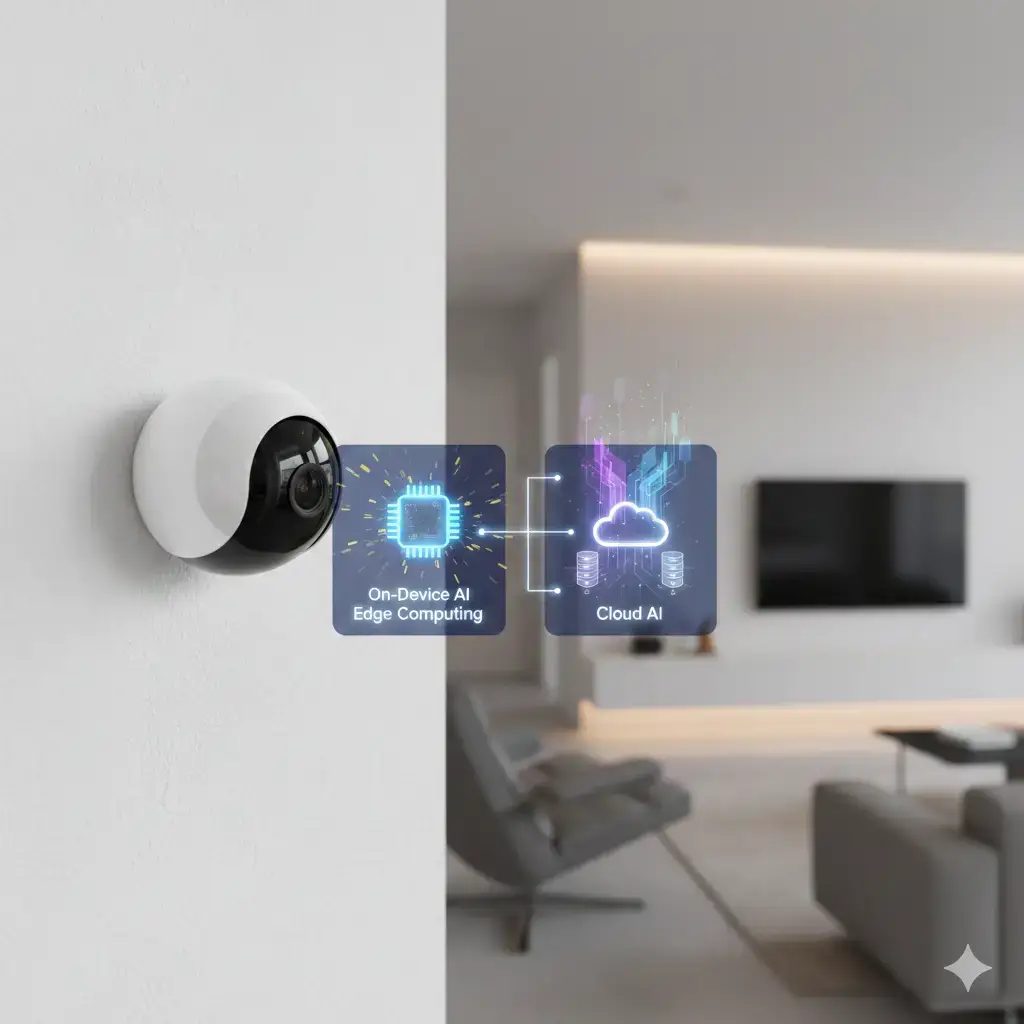
Smart home cameras are evolving rapidly as artificial intelligence becomes central to features like person detection, pet recognition, and real-time alerts. But relying entirely on cloud AI creates latency and privacy concerns, while purely on-device AI is limited by hardware constraints. Hybrid on-device and cloud AI improves smart home cameras by combining low-latency local inference with scalable cloud intelligence—creating a balanced, efficient, and privacy-aware system architecture. For a deeper comparison of standalone architectures, see our detailed breakdown of On-device AI vs Cloud AI, which explores the trade-offs in latency, privacy, and scalability. This explains how hybrid on-device and cloud AI improves smart home cameras by balancing real-time responsiveness, scalability, and privacy.
What Is Hybrid On-Device and Cloud AI?
Hybrid on-device and cloud AI refers to an architecture that strategically partitions artificial intelligence computational tasks between an embedded device, such as a smart home camera, and a remote cloud computing platform.
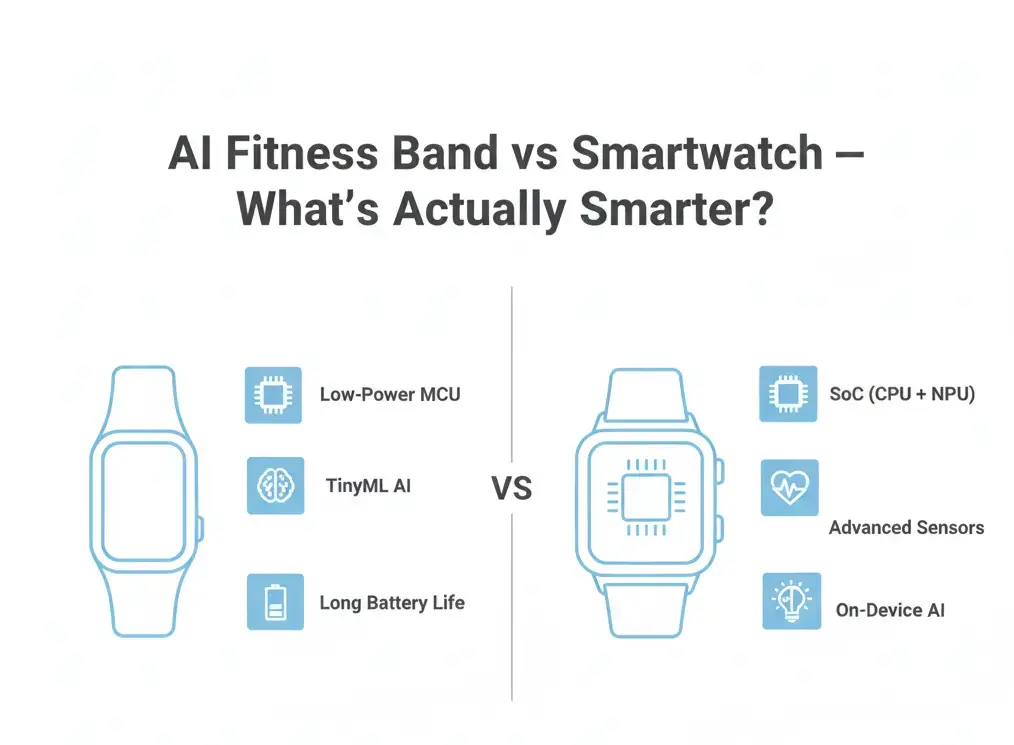
On-device AI, also known as Edge AI, executes AI inference directly on the camera’s integrated System-on-Chip (SoC). This typically uses specialized hardware blocks such as Neural Processing Units (NPUs) or Digital Signal Processors (DSPs) to run optimized, smaller neural network models. On-device AI models are typically optimized using frameworks such as TensorFlow Lite, which are specifically designed for efficient, low-latency inference on embedded hardware. Its primary advantages include low latency and enhanced data privacy, as raw data often remains local.
Cloud AI, conversely, leverages the extensive computational resources of remote data centers. This enables the deployment of larger, more complex AI models, extensive data analysis, and global model updates. While offering superior processing power and scalability, pure cloud AI introduces network latency, requires continuous high-bandwidth internet, and raises privacy concerns due to constant data upload. The hybrid model mitigates the drawbacks of each standalone approach.
How It Works
The operational flow of hybrid AI in smart home cameras begins with data capture at the device level. The image sensor continuously feeds video frames to the local processor, where an optimized, lightweight AI model performs the first inference pass.
This model is typically compiled for the specific on-device accelerator (NPU or DSP) and is designed for efficient, low-latency processing. It handles high-frequency tasks such as motion detection, person detection, and sound event classification without requiring cloud connectivity.
If the on-device model identifies a significant event, it triggers further action. For example, after detecting a person, the camera may locally buffer a short video clip. It can then apply additional local analysis to refine the detection, such as distinguishing a known household member from an unknown visitor.
Once refined, the system determines whether to upload a compressed video clip or only metadata (for example, “person detected at front door”) to the cloud. Cloud-based services then execute more complex processing, including large-scale facial recognition, long-term behavioral pattern analysis, or human verification for ambiguous cases.
This selective data upload significantly reduces bandwidth consumption while minimizing the amount of sensitive raw video leaving the device. This workflow closely resembles an On-Device AI Cloud Fallback architecture, where real-time inference is handled locally and only computationally intensive tasks are escalated to the cloud when necessary.
Architecture Overview
The architecture of a hybrid AI smart home camera involves a tightly integrated system spanning the edge device and the cloud infrastructure.
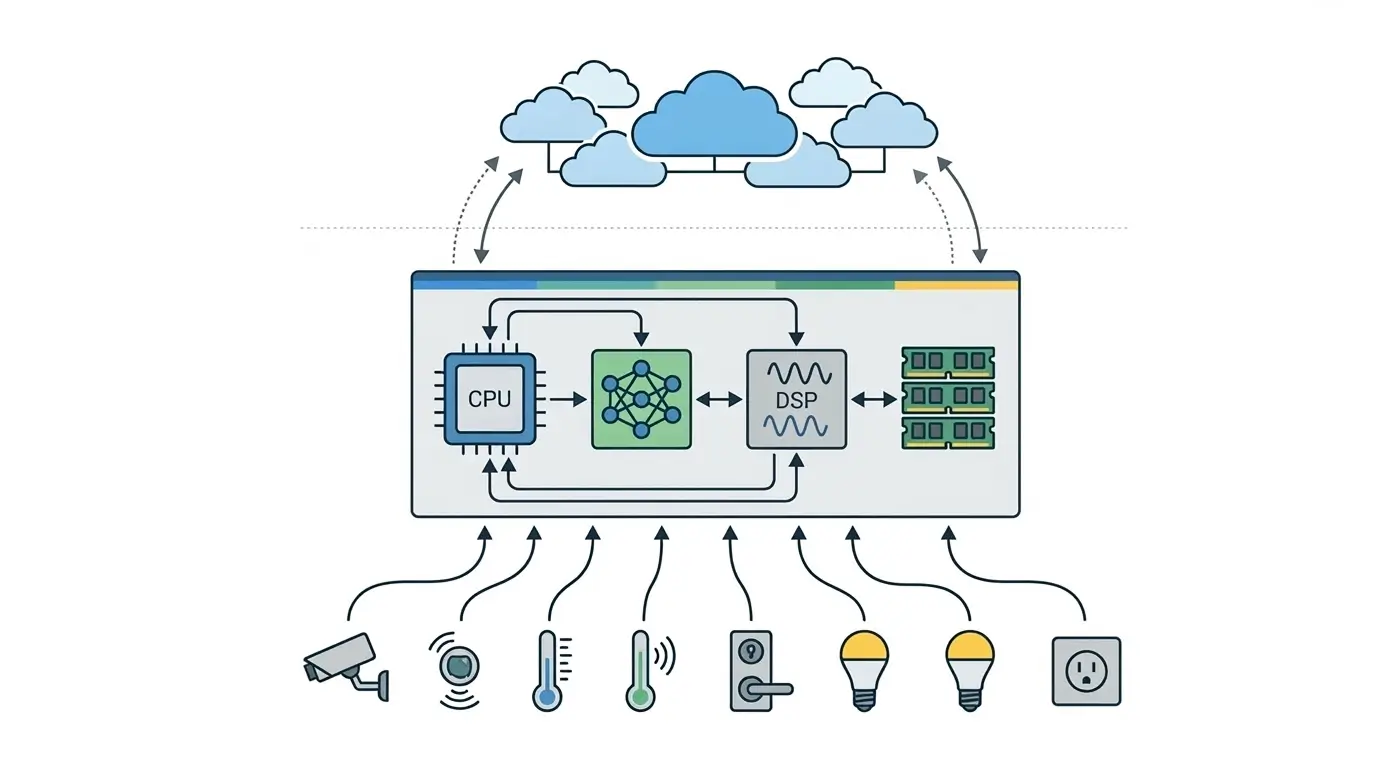
On the device side, key components include the image sensor, an SoC with a CPU, GPU, and often a dedicated NPU or DSP for efficient AI inference. Memory (RAM, flash storage) is crucial for buffering video and storing AI models, while connectivity modules (Wi-Fi, Bluetooth) handle communication.
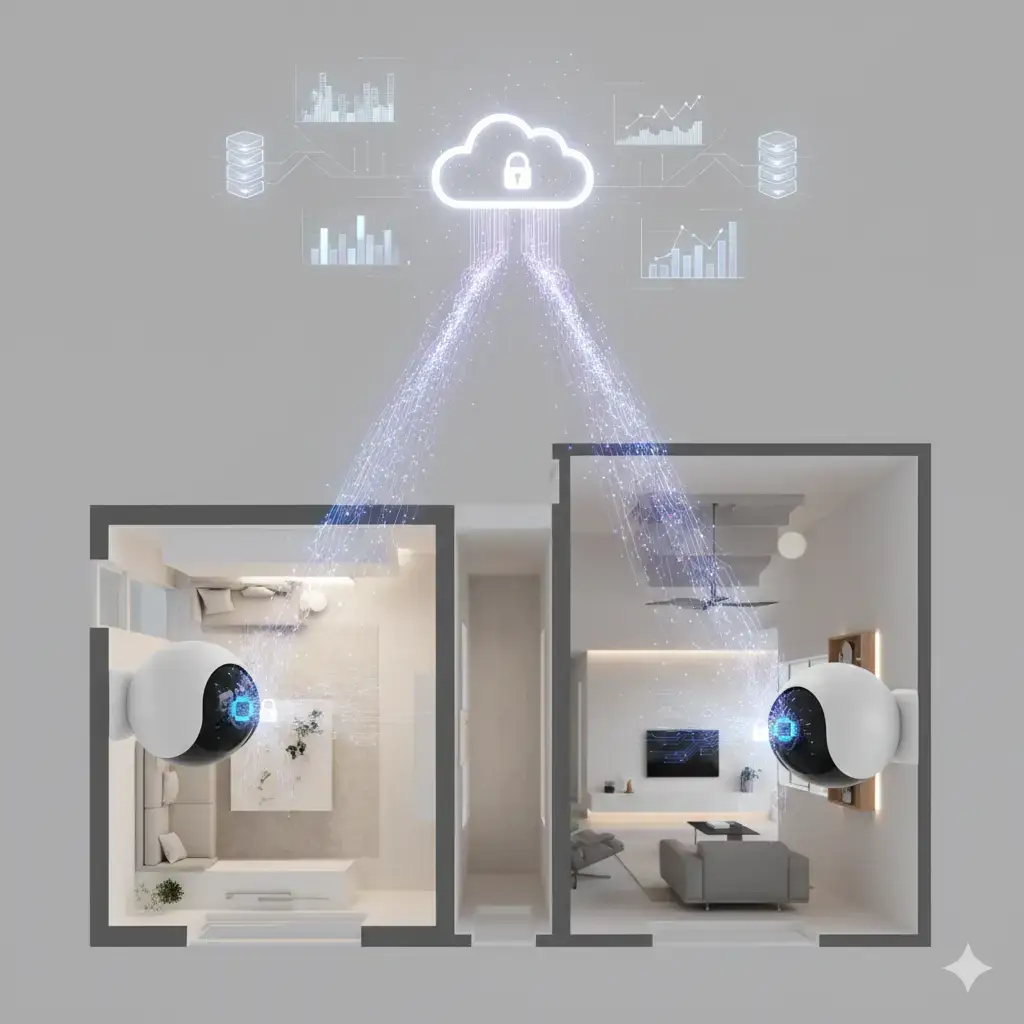
Large-scale model training and advanced analytics are often deployed on platforms such as Google Cloud AI, which provide scalable GPU infrastructure for distributed AI workloads. In the cloud, the architecture comprises scalable compute clusters (often GPU-accelerated), large-scale data storage, and a suite of AI services for advanced analytics, model training, and deployment. A robust API gateway manages communication with edge devices, and a message queue system handles event notifications and data streams.
| Attribute | Details |
|---|---|
| Processing Location | Camera’s SoC (NPU/DSP/CPU) and Remote Data Centers |
| Computational Power | Limited, optimized for low power (on-device) |
| Data Transfer | Minimal (metadata, event clips) |
| Latency | Milliseconds (local processing) |
| Privacy Implication | Raw data often stays local |
| Power Consumption | Optimized for low-power bursts (on-device) |
Performance Characteristics
Hybrid AI systems optimize several key performance characteristics.
Latency is significantly reduced for critical events because initial processing occurs on-device, enabling near-instantaneous alerts. For example, a doorbell camera can detect a person and trigger an alert within milliseconds locally, even if the full video upload to the cloud takes longer.
Throughput, or the volume of data processed, is managed by offloading less critical or more computationally intensive tasks to the cloud. This prevents the camera’s limited hardware from becoming a bottleneck.
Power efficiency is a major design consideration for battery-powered cameras. On-device AI accelerators are designed for bursty, efficient inference, minimizing power draw within power limits. Sustained, high-utilization workloads are avoided locally to prevent rapid battery drain and thermal throttling, subject to thermal constraints.
Accuracy benefits from the cloud’s ability to run larger, more sophisticated models and leverage global data for continuous improvement. The on-device model acts as a highly efficient filter, ensuring that only relevant data is sent to the cloud for higher-fidelity analysis, thus improving overall system accuracy while managing resource usage. These performance gains further illustrate how hybrid on-device and cloud AI improves smart home cameras in latency-sensitive environments.
Real-World Applications
Hybrid on-device and cloud AI enhances smart home cameras in several practical ways.
For instance, many battery-powered cameras perform basic motion detection and person identification entirely on-device. This conserves battery life by only activating higher-power components or uploading video to the cloud when a confirmed event occurs.
Apple’s HomeKit Secure Video (HKSV) compatible cameras utilize on-device processing for person, pet, and vehicle detection. This ensures that raw video only leaves the device after local analysis, and then only in an encrypted format to iCloud.
Another application involves smart displays with integrated cameras, like the Google Nest Hub Max. These devices can perform local facial recognition to identify household members, triggering personalized greetings or information displays, while more complex video analytics or long-term trend analysis might be handled in the cloud. This split ensures immediate, personalized responses while leveraging cloud power for broader insights.
Advanced professional security cameras, while not strictly “smart home,” also employ this model. Local models handle immediate threat detection, and the cloud provides forensic analysis and global threat intelligence.
Limitations
Despite its advantages, hybrid on-device and cloud AI faces several limitations.
The system’s overall reliability remains dependent on a stable internet connection. While basic local functions may persist, advanced cloud-based features can be impaired or fail without connectivity. This introduces a single point of failure for comprehensive AI capabilities.
Complexity presents another challenge. Designing, deploying, and maintaining a hybrid system requires expertise in both embedded systems and cloud infrastructure. This includes managing model versions across diverse hardware, ensuring secure data transfer, and orchestrating task handoffs. Such complexity can increase development costs and time-to-market.
Hardware constraints on the device side, such as limited battery capacity and thermal envelopes, restrict the sophistication of on-device AI models. Small camera form factors limit heat dissipation, leading to thermal throttling if sustained high-performance processing is attempted. This means the on-device component can only handle specific, optimized tasks, necessitating careful partitioning of AI workloads.
Finally, the ongoing operational costs associated with cloud computing, while optimized by reduced bandwidth, still represent a recurring expense for users or service providers. Even with its trade-offs, this model reinforces how hybrid on-device and cloud AI improves smart home cameras by intelligently balancing performance and resource constraints.
Why Hybrid AI Matters for Smart Home Cameras
This hybrid approach directly addresses fundamental trade-offs in smart home security and automation.
Strategically distributing AI workloads, it significantly enhances user privacy by minimizing the amount of raw video data that leaves the home. It also significantly reduces latency for critical alerts, ensuring users are notified of important events almost instantaneously, which is vital for security applications. This approach aligns with industry standards such as the NIST IoT security guidelines, which emphasize minimizing data transmission and securing device-to-cloud communication.
Furthermore, hybrid AI optimizes bandwidth usage, lowering internet data consumption and potentially reducing cloud storage costs. This makes advanced AI features more accessible and sustainable for a wider range of users, especially those with limited internet plans. It also improves the robustness of smart home systems, allowing basic functionalities to persist even during internet outages.
Ultimately, this paradigm shift enables more powerful, reliable, and user-centric AI experiences in embedded systems, moving beyond the limitations of purely local or purely remote processing. This demonstrates how hybrid on-device and cloud AI improves smart home cameras by delivering scalable intelligence without compromising user privacy.
Edge AI vs Cloud AI vs Hybrid AI (Comparison Table)
| Feature | On-Device AI | Cloud AI | Hybrid AI |
| Latency | Very Low | High (network dependent) | Low |
| Privacy | High | Lower | Optimized |
| Power Consumption | Limited by Battery | High compute | Balanced |
| Model Complexity | Small Models | Large models | Tiered models |
| Internet Dependency | Minimal | Required | Partial |
Key Takeaways
- Hybrid AI in smart home cameras splits processing between the device and cloud to balance performance, privacy, and efficiency.
- On-device AI handles immediate, low-latency tasks like motion and person detection, conserving bandwidth and enhancing privacy.
- Cloud AI provides scalable compute for complex analytics, global model updates, and long-term pattern recognition.
- Hardware constraints like battery life, thermal limits, and sustained workload capabilities dictate the scope of on-device processing.
- This approach reduces latency for critical alerts, lowers bandwidth consumption, and improves system robustness against connectivity issues. Overall, this is how hybrid on-device and cloud AI improves smart home cameras in a scalable, privacy-conscious, and performance-driven manner.