
Table of Contents
Why Wearable AI Performance Drops Under Heat
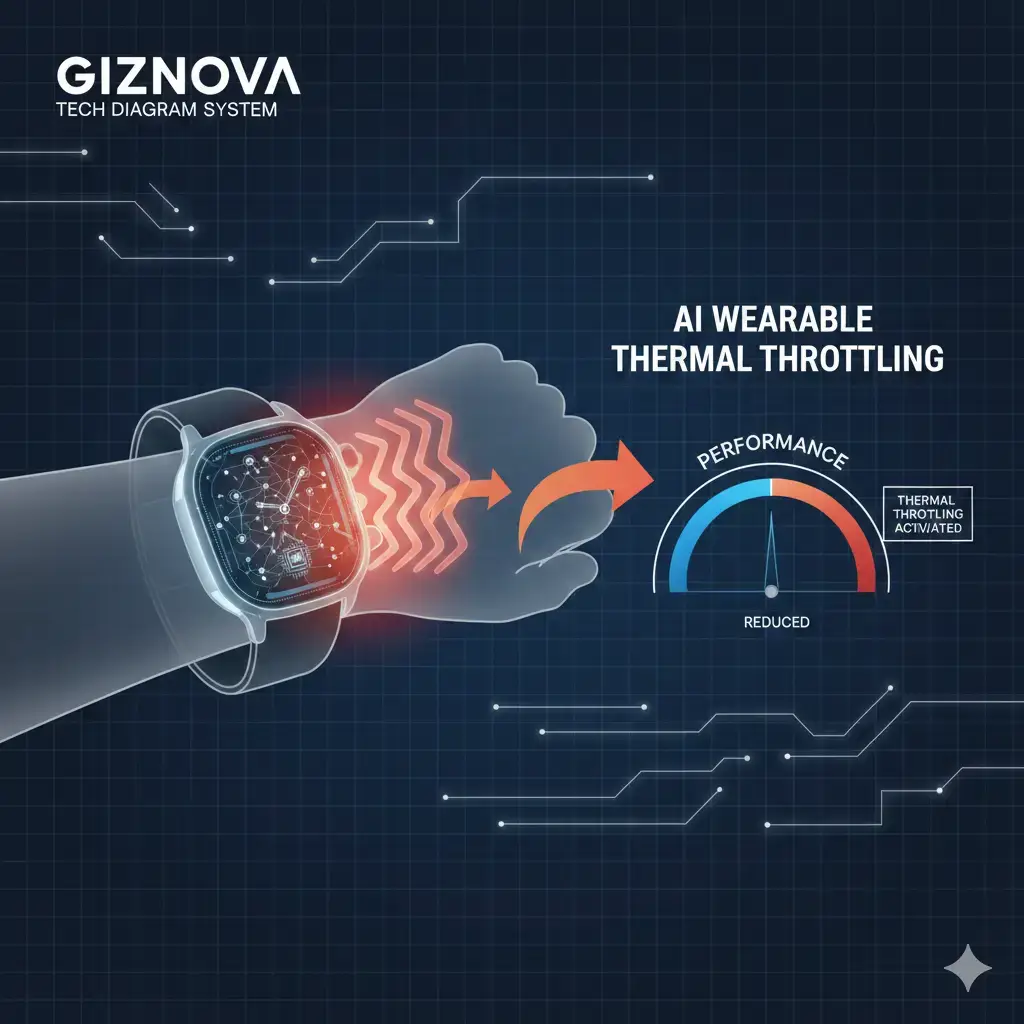
AI Wearable Thermal Throttling is a fundamental performance constraint in modern AI-enabled wearables. These devices run complex machine-learning workloads in extremely compact, passively cooled hardware. Similar constraints already shape how on-device AI compares to cloud AI processing. where heat buildup occurs rapidly. As AI accelerators such as NPUs and GPUs operate continuously, rising junction temperatures increase electrical resistance and leakage currents, threatening chip stability and user safety.
To prevent overheating and maintain external surface temperatures within safe limits (typically below 40–45°C), wearable systems automatically reduce clock speed and voltage — a protective mechanism known as thermal throttling. While essential for hardware reliability, AI Wearable Thermal Throttling directly lowers inference speed, increases latency, and limits how long high-performance AI tasks can run. This is not a software issue but a physical limit driven by power density, heat dissipation pathways, and wearable form-factor constraints. This is why AI Wearable Thermal Throttling is considered a core design constraint in modern wearable AI systems.
Quick Answer
AI Wearable Thermal Throttling is the automatic reduction of a device’s processing power (e.g., clock speed, voltage) by its thermal management system to prevent internal components from overheating, ensuring operational stability and user safety. This mechanism is crucial for sustained AI performance in compact, power-constrained wearable form factors where heat dissipation is inherently limited.
How AI Wearable Thermal Throttling Affects AI Processing
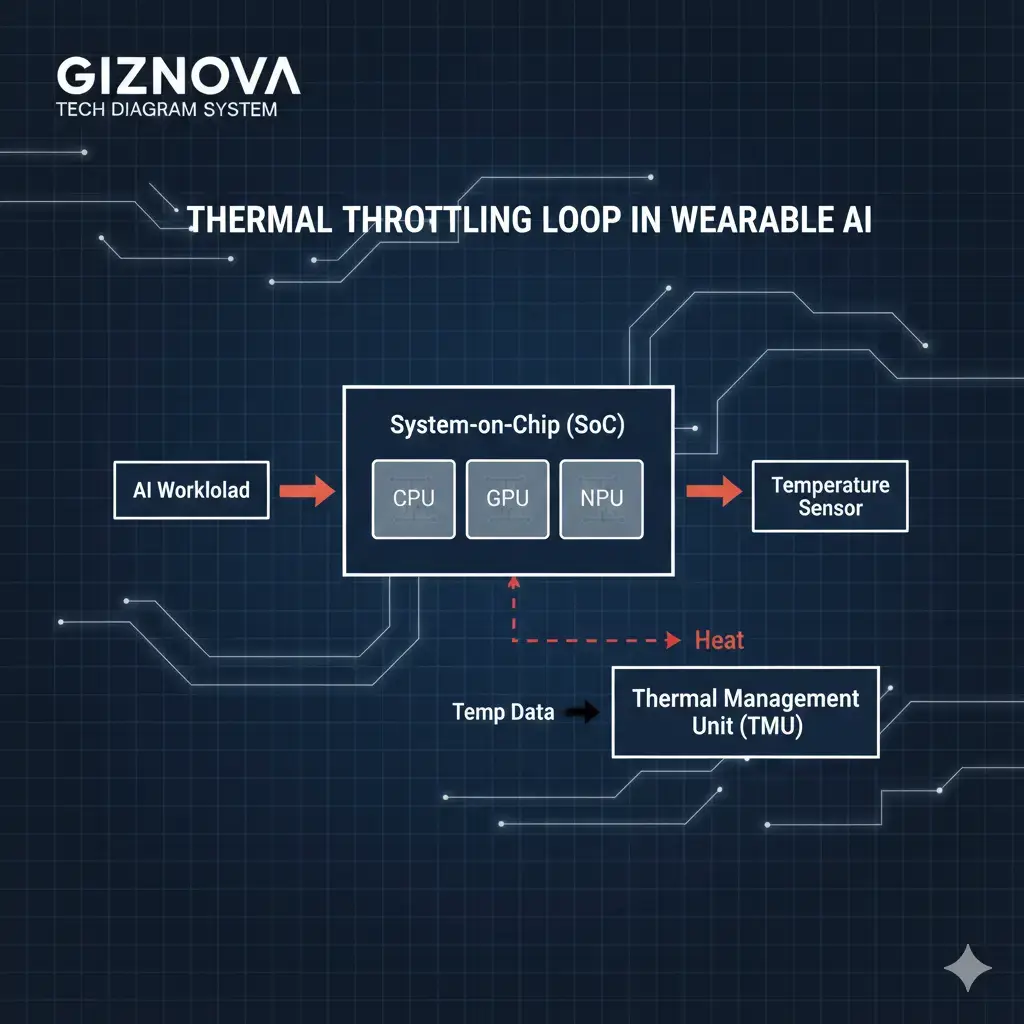
In practice, thermal throttling directly impacts AI processing by reducing the available computational cycles and memory bandwidth, which can be a critical bottleneck for large models. When a System-on-Chip (SoC) throttles, its CPU, GPU, and dedicated Neural Processing Units (NPUs) — the same AI chips explained in modern mobile processors operate at lower clock frequencies and voltages. For AI, this translates to slower inference speeds, increased latency for real-time applications like voice assistants or gesture recognition, and a reduced capacity for complex model execution, often forcing smaller, quantized models. For instance, continuous deep neural network (DNN) inference on a mobile GPU can degrade significantly, with frames per second (FPS) throughput potentially dropping 2-9x below peak once vendor-defined temperature thresholds are crossed.
This often forces AI tasks to either run less frequently, process smaller data batches, or utilize simpler, less accurate models to maintain responsiveness, significantly impacting peak performance. This constraint directly influences the architectural design and optimization strategies for AI models intended for edge deployment.
What Causes Heat Buildup in Wearable AI Hardware
Heat buildup in wearable AI hardware is primarily driven by power density—the amount of electrical power dissipated per unit area of silicon. AI accelerators execute billions of operations per second, and every transistor switch produces resistive (I²R) losses and leakage currents that convert electrical energy into heat. In wearables, the System-on-Chip (SoC), wireless radios, and power management ICs are tightly clustered, often within a PCB footprint close to 1 cm². Chip designers constantly optimize this balance in mobile architectures. This creates localized hotspots that are difficult to spread or dissipate. This localized power density is one of the primary physical drivers behind AI Wearable Thermal Throttling in compact devices.
Unlike laptops or servers, wearables have:
No active airflow
Minimal internal thermal mass
Enclosures designed for water resistance, which trap heat
As a result, heat must conduct through thin PCB layers, graphite sheets, or casing materials. When heat generation exceeds the rate of dissipation, internal temperatures rise quickly, especially during sustained AI workloads such as continuous speech recognition or real-time sensor fusion.
The Hidden Power and Thermal Management System
Behind the scenes, wearable devices run a tightly integrated Power and Thermal Management System (PTMS). This system combines:
On-chip thermal sensors
Power Management ICs (PMICs)
DVFS (Dynamic Voltage and Frequency Scaling) is a standard control mechanism used in operating system governors. These control loops operate specifically to regulate AI Wearable Thermal Throttling, keeping temperatures within safe limits while sacrificing peak performance when necessary.
Firmware control loops
These components continuously monitor junction temperatures and workload intensity. When thermal headroom decreases, the PTMS reduces the voltage and clock frequency of the CPU, GPU, or NPU. This closed-loop system operates autonomously, often reacting in milliseconds.
Importantly, AI workloads are often treated differently from general compute tasks. Some systems implement thermal-aware scheduling, dynamically shifting inference between processing units (e.g., GPU → NPU) to balance performance with thermal load.
Why Compact Hardware Struggles With Sustained AI Workloads
Compact hardware inherently struggles with sustained AI workloads due to fundamental physical limitations in heat dissipation. Unlike larger devices, wearables lack the surface area for efficient convective heat transfer to the ambient environment. The extremely limited internal volume precludes the integration of active cooling solutions like micro-fans or thermoelectric coolers (Peltier elements), which are too bulky, noisy, and power-hungry for typical wearable battery capacities, often limited to a few hundred milliamp-hours.
This “three-way constraint” of miniaturization, user proximity, and sealed packaging means that heat must primarily be conducted through the PCB materials and the device housing, a process that is slow and inefficient for the power densities involved in modern AI processing. These are architectural limits, not temporary design choices.
What Wearable AI Chips Can (and Can’t) Sustain
Wearable AI chips are specifically designed to sustain short, bursty AI workloads efficiently. This includes tasks like quick voice command recognition, single-frame image analysis, or intermittent biometric data processing. Their optimized Neural Processing Units (NPUs) deliver high TOPS/W (Tera Operations Per Second per Watt) for these brief periods. However, they generally cannot sustain continuous, complex AI tasks such as always-on, high-resolution vision processing, real-time multi-modal AI fusion, or prolonged, intensive deep learning inference.
Such demanding workloads quickly push the SoC beyond its thermal design power (TDP) limits, leading to rapid temperature increases and inevitable throttling, forcing a reduction in performance from peak levels or even temporary suspension of the AI function. This reality informs the architectural choices for AI models deployed on wearables, emphasizing efficiency and task segmentation.
The Tradeoff: Performance vs Heat vs Battery Life
The design of AI-enabled wearables is a constant negotiation between three critical, often conflicting, parameters: performance, heat generation, and battery life. Achieving higher AI performance typically requires more power, which directly translates into increased heat dissipation. Conversely, aggressive thermal management to keep temperatures low often necessitates reducing clock speeds and voltages, thereby sacrificing peak performance. Extending battery life, a paramount concern for wearables, means limiting the overall power budget, typically to a few watts sustained, which in turn restricts the intensity and duration of AI workloads.
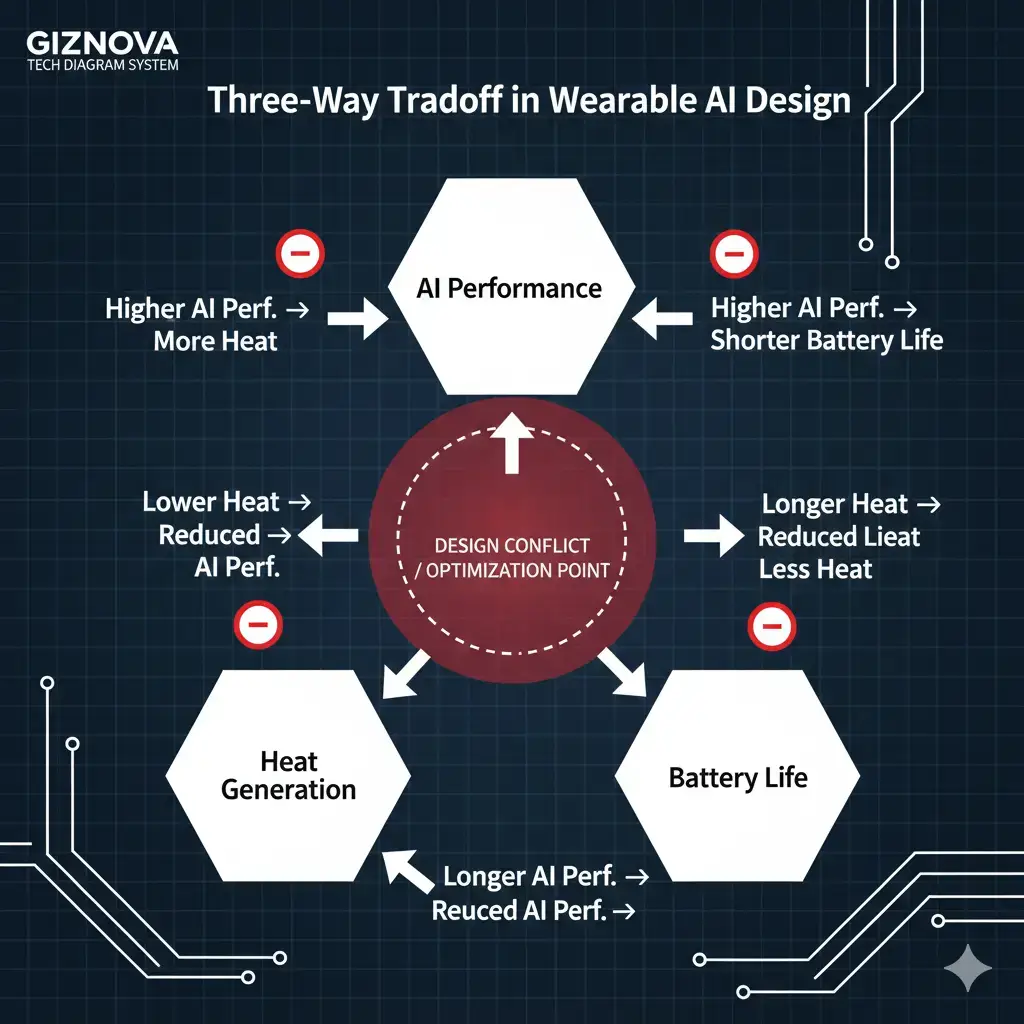
Engineers must meticulously balance these factors, making strategic tradeoffs based on the device’s primary function and target user experience, understanding that optimizing one aspect often compromises the others. This is a fundamental system-level tradeoff in wearable AI architecture. This three-way balance ultimately defines how aggressively AI Wearable Thermal Throttling must intervene during sustained workloads.
Real Examples of Thermal Limits in Wearable Devices
From a user perspective, thermal limits manifest in various ways across wearable devices. In smartwatches, for instance, users often experience reduced display refresh rates or slower application responsiveness during extended periods of intensive activity tracking with continuous heart rate monitoring and GPS, especially if combined with complex AI-driven health insights. These performance limits are similar to how AI makes smartwatches smarter while balancing battery and heat.
Augmented Reality (AR) glasses, when performing continuous object recognition or complex scene understanding—tasks that often involve large models and high memory bandwidth—can dim their displays, reduce frame rates, or even temporarily pause AI features to mitigate the risk of overheating. Similarly, hearables attempting real-time language translation or advanced noise cancellation can exhibit intermittent performance or reduced battery life as their compact processors struggle to sustain these computationally intensive AI tasks without throttling.
Maintaining external device surface temperatures below 40-45°C is a constant challenge, often dictating the maximum sustained AI load and shaping the architectural capabilities of the device.
How Engineers Mitigate AI Thermal Throttling
Engineers tackle thermal throttling using a combination of hardware, materials, and software strategies:
Hardware & Materials
Ultra-efficient NPUs with high TOPS/W
Graphite heat spreaders with high in-plane conductivity
Thermal vias and copper planes in PCBs
Ceramic or aluminum-backed substrates
Software & System Strategies
Model quantization and pruning
Dynamic workload scheduling
Duty cycling AI tasks
Offloading heavy inference to smartphones or edge devices
The goal is not to eliminate heat but to reduce sustained thermal load and extend the duration of peak performance before throttling occurs.
Where Wearable AI Hardware Is Headed Next
Looking ahead, the future of wearable AI hardware is set to focus on pushing the boundaries of efficiency and integration. We can anticipate advancements in ultra-low-power AI accelerators (NPUs) that deliver significantly higher TOPS/W, enabling more complex on-device inference with less heat generation. Advanced packaging technologies, such as chiplets and 3D stacking, are anticipated to allow for denser integration of components while also improving thermal pathways. Battery technology is projected to continue to evolve, offering higher energy densities and faster charging to support more demanding AI workloads.
Furthermore, thermal management is expected to become more sophisticated, incorporating predictive AI algorithms that anticipate heat buildup and proactively adjust workloads. The trend towards distributed AI, seamlessly offloading tasks between the wearable, a connected smartphone (which typically has 4-16GB RAM), and the cloud, is also anticipated to be a crucial architectural direction for scaling AI capabilities beyond the physical limits of the wearable itself.
How This Fits Into the Bigger AI Hardware Landscape
The thermal challenges in wearables mirror those seen across the AI hardware ecosystem, just at smaller scales. Smartphones, edge devices, and even data center accelerators face the same tradeoff: higher AI performance leads to higher power density and heat. However, while servers use liquid cooling and large heat sinks, wearables must rely almost entirely on passive conduction and intelligent workload management.
This makes wearable AI hardware a microcosm of edge AI engineering, where efficiency, packaging, and system-level optimization matter more than raw compute capability. In this sense, AI Wearable Thermal Throttling reflects the same physics-driven limits seen across edge AI systems.
Key Takeaways
- Fundamental Constraint: Thermal throttling is an unavoidable physical consequence of running powerful AI workloads in compact, heat-constrained wearable devices, representing an architectural limit.
- Performance vs. Limits: It directly reduces AI inference speed and increases latency from peak levels to mitigate the risk of overheating and component damage, shaping system-level performance.
- Multi-Source Heat: Heat buildup is caused by high power density from SoCs, inefficient computation, and restricted heat dissipation in sealed enclosures, all critical hardware constraints.
- Sophisticated Management: Devices rely on hidden thermal management units, DVFS, and power management ICs, often with context-aware scheduling, to control temperatures, embodying system-level tradeoffs.
- Engineering Tradeoff: Balancing AI performance, heat generation, and battery life is a core challenge, with improvements in one often compromising another, a constant in device architecture.
- Future Focus: Advancements are expected to center on ultra-efficient AI accelerators, advanced packaging, improved thermal materials, and sophisticated distributed AI architectures, reflecting an industry direction driven by physical limits.
What This Is Based On (Tech & Research)
This explanation is based on fundamental principles of semiconductor physics, which dictate that chip performance and reliability are temperature-dependent. It draws from thermal dynamics; these principles form the basis of modern electronic thermal design. covering heat conduction, convection, and radiation, as applied to constrained electronic enclosures. The discussion incorporates insights from advanced material science regarding thermal interface materials and heat spreaders, as well as power electronics engineering for Power Management ICs (PMICs) and Dynamic Voltage and Frequency Scaling (DVFS). These strategies are designed not to eliminate AI Wearable Thermal Throttling, but to delay its onset and reduce its impacFurthermore, it integrates concepts from AI model optimization, heterogeneous computing architectures, and distributed computing paradigms that are essential for managing complex AI workloads within the stringent power and thermal envelopes of wearable technology, all grounded in real hardware capabilities and limitations.
Conclusion: The Future of Sustained AI Performance in Wearables
The challenge of thermal throttling will remain a defining characteristic of AI-enabled wearables for the foreseeable future. It is a testament to the laws of physics and the inherent limitations of miniaturization. However, the relentless pace of innovation in semiconductor design, material science, and software intelligence continues to push these boundaries. Future advances aim to reduce the impact of AI Wearable Thermal Throttling, not eliminate it. Sustained AI performance in wearables will not come from a single breakthrough but from a synergistic combination of ultra-efficient, purpose-built AI accelerators, advanced passive thermal solutions, intelligent and predictive thermal management algorithms, and a seamless integration with distributed AI processing capabilities across the broader edge-cloud ecosystem. This holistic approach will ultimately enable wearables to deliver increasingly powerful and continuous AI experiences without compromising user comfort or device longevity.
Frequently Asked Questions
Q1:Is thermal throttling bad for my wearable device?
A: No, thermal throttling is a necessary and intentional protective mechanism. It prevents your device’s internal components from overheating and sustaining permanent damage, ensuring its longevity and safe operation, especially during intensive AI tasks.
Q2: Can I prevent my wearable AI device from thermally throttling?
A: User control over thermal throttling is generally limited. It’s an automatic system response. Keeping your device in a cooler environment, ensuring good airflow around it (if applicable), and avoiding running multiple intensive AI applications simultaneously can help delay its onset.
Q3: Does the ambient temperature affect how quickly my wearable AI device throttles?
A: Yes, significantly. A higher ambient temperature reduces the temperature differential between the device and its surroundings, making it harder for heat to dissipate. This means your wearable will reach its thermal limits and throttle faster in a hot environment compared to a cool one.
Q4: What’s the main difference between passive and active cooling for AI wearables?
A: Passive cooling relies on materials like graphite sheets, heat pipes, and advanced casings to conduct and radiate heat away without consuming power. Active cooling, which is rare in consumer wearables due to size, power, and noise constraints, uses powered components like micro-fans or thermoelectric coolers to actively move heat.
Q5: Will wearable AI devices ever be able to run complex AI models continuously without throttling?
A: Running highly complex AI models continuously solely on a wearable device without any throttling is unlikely due to fundamental power and thermal limits. The future lies in distributed AI, where computationally intensive tasks are intelligently offloaded to a connected smartphone, edge device, or cloud, allowing the wearable to focus on essential, low-latency AI functions and user interaction.