Table of Contents
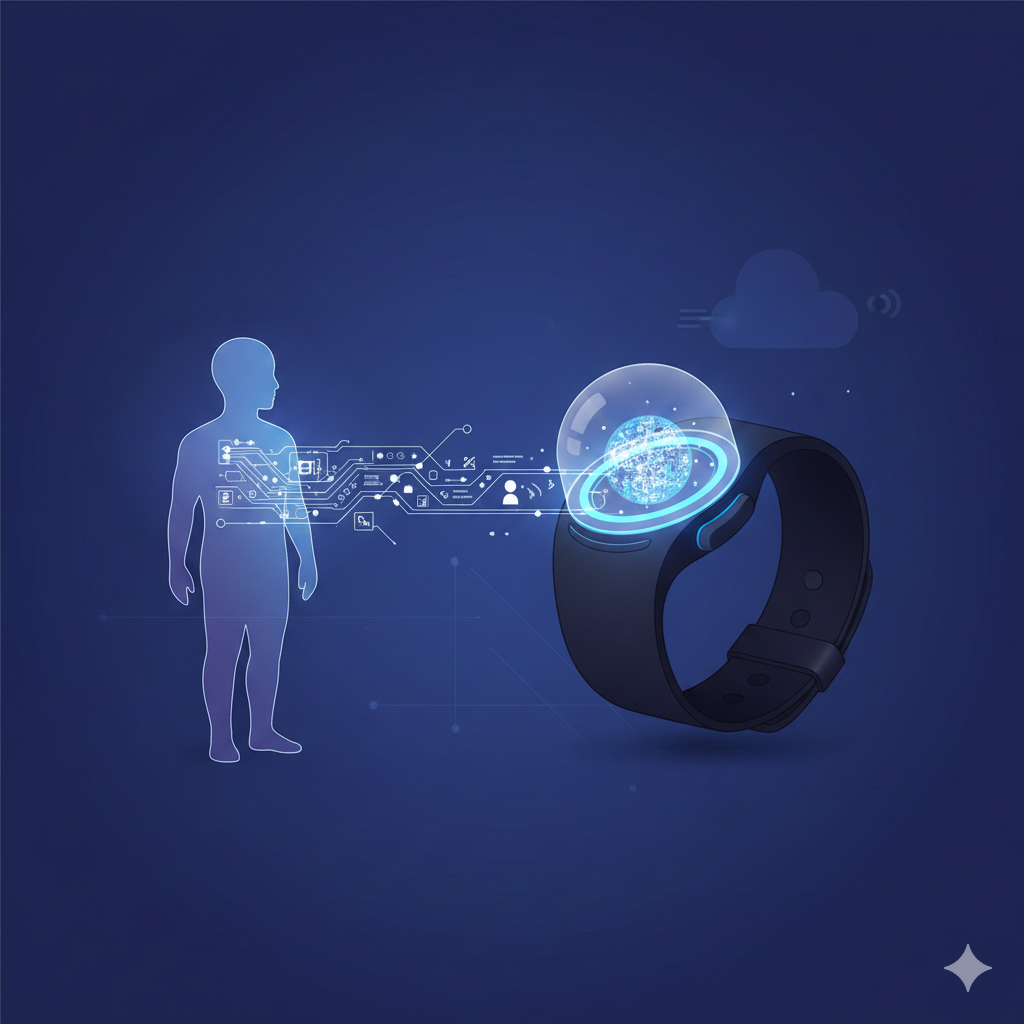
AI Smart Rings Explained: AI smart rings are small wearable devices that use biometric sensors and ultra-low-power AI chips to continuously track health. Instead of sending raw data to the cloud, they run lightweight AI models directly on the device to analyze signals like heart rate, sleep patterns, and activity. This on-device processing helps preserve privacy while maintaining multi-day battery life in a compact form factor.
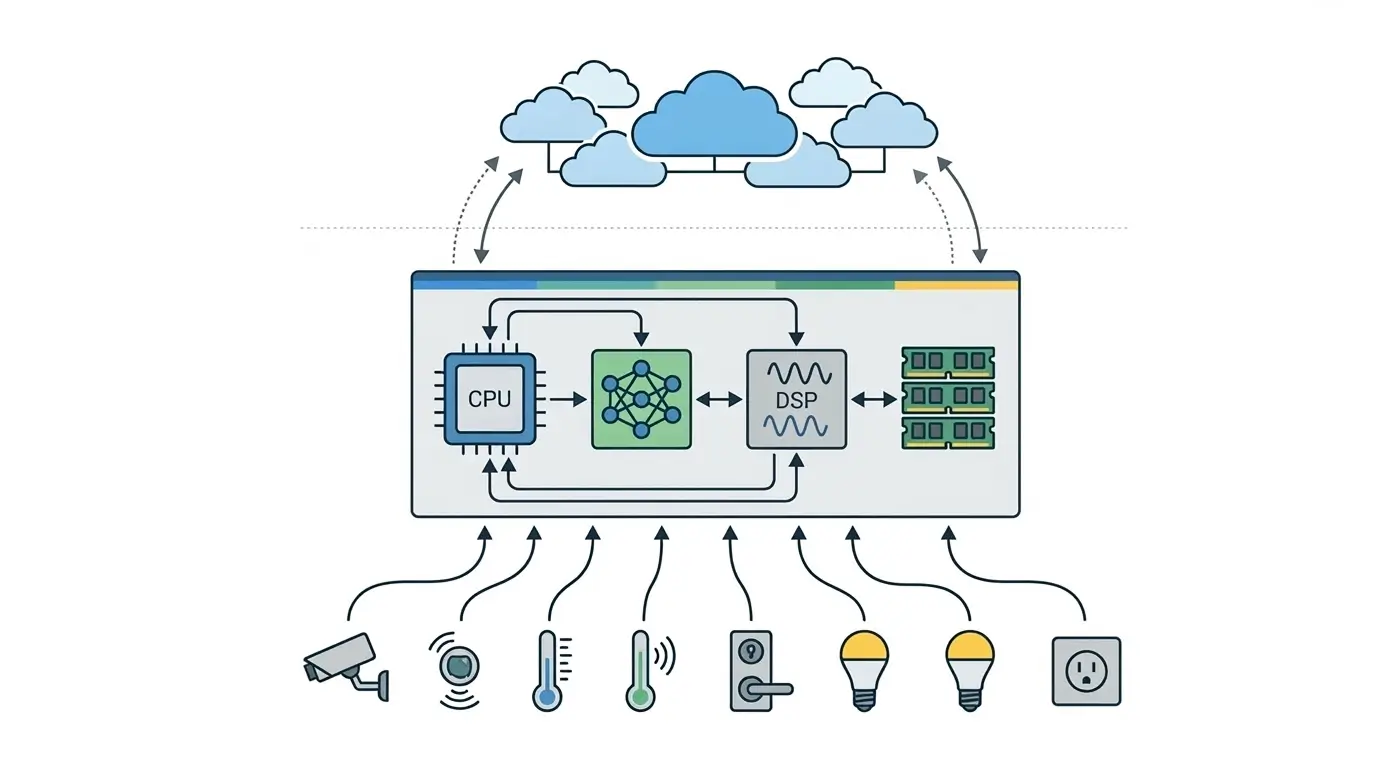
These devices represent a growing wave of ultra-compact hardware bringing artificial intelligence directly to the edge. Many of these devices rely on on-device AI processing rather than cloud computation, a concept explored in our comparison of On-Device AI vs Cloud AI. Unlike traditional wearables that rely heavily on smartphones or cloud processing, smart rings must analyze biometric data within extremely tight limits on power, memory, and heat. This creates a unique engineering challenge: delivering continuous health insights using tiny sensors and ultra-low-power processors inside a device small enough to wear on a finger. Solving this problem requires careful optimization of silicon design, runtime scheduling, and on-device AI models.
What It Is
An AI smart ring is a wearable computing device, typically worn on a finger, that integrates multiple physiological sensors (e.g., Photoplethysmography (PPG) for heart rate/SpO2, accelerometer/gyroscope for activity, temperature sensors) with an ultra-low-power System-on-Chip (SoC) featuring an embedded AI inference engine. Its primary function is continuous, passive data acquisition and on-device processing to derive health insights, such as sleep stages, activity levels, stress indicators, and early illness detection.
Many wearable AI devices rely on extremely compact machine-learning models designed for microcontrollers. Research initiatives such as the TinyML Foundation research on running AI on microcontrollers explore how neural networks can run efficiently on ultra-low-power embedded hardware.
The design is fundamentally driven by the imperative for multi-day battery life and an unobtrusive form factor, dictating severe constraints on power, memory, and computational resources. This ensures the device remains comfortable and functional for extended periods without frequent recharging.
How It Works
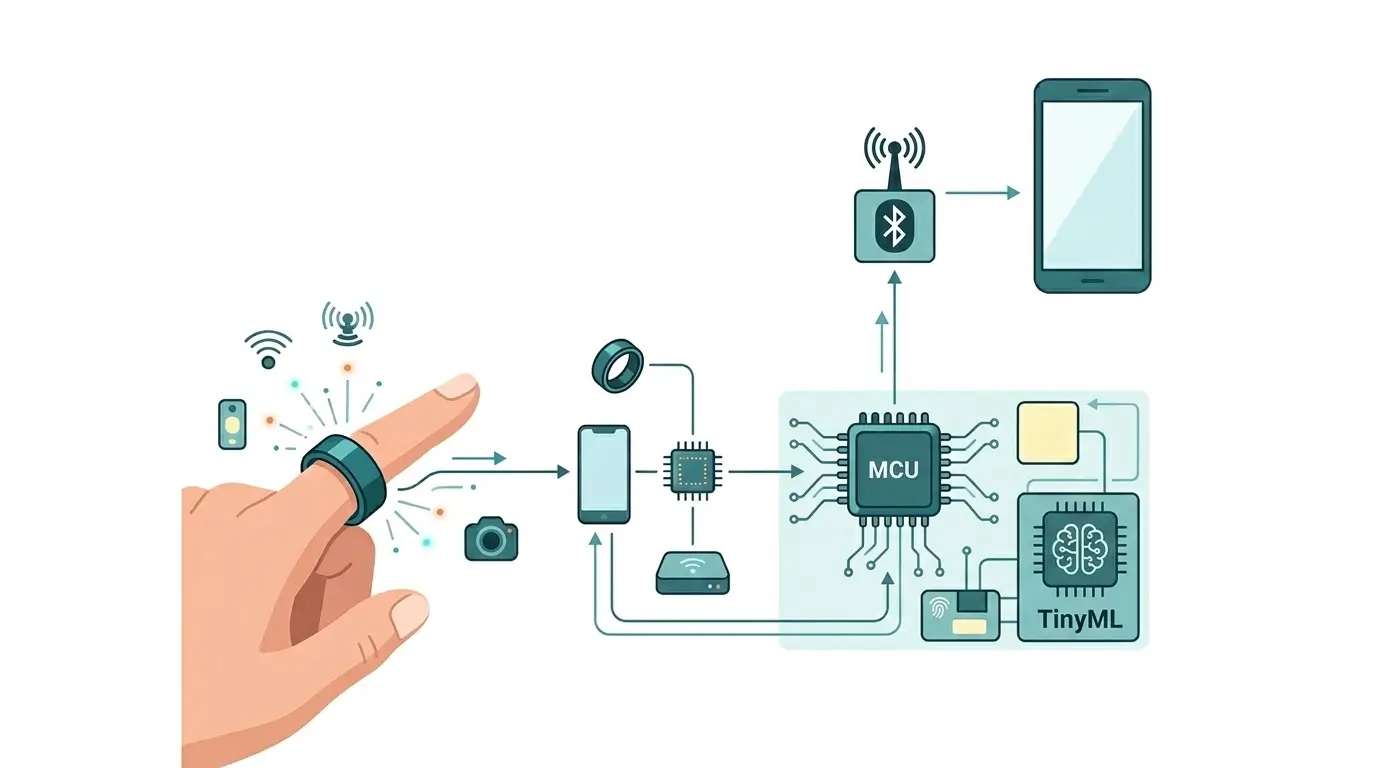
This architecture is central to how AI Smart Rings Explained devices can process health data locally without relying on cloud infrastructure. The operational paradigm of an AI smart ring revolves around aggressive power management and event-driven runtime scheduling. Sensors continuously acquire raw biometric data, which is then fed into a highly optimized, on-device AI model for inference.
- Sensor Acquisition & Pre-processing: Low-power sensors are duty-cycled and activated by the Microcontroller Unit (MCU) based on a predefined runtime schedule or detected events. Raw analog signals are digitized and often undergo initial filtering or feature extraction (e.g., peak detection, statistical aggregation) by the MCU or a dedicated Digital Signal Processor (DSP) to reduce data volume before AI inference.
- On-Device AI Inference: The pre-processed data is fed into a specialized AI accelerator or utilizes the main MCU’s DSP capabilities. These inference engines execute highly quantized (e.g., 8-bit or 4-bit integer) neural network models, typically optimized for time-series analysis (e.g., Convolutional Neural Networks (CNNs), Long Short-Term Memory (LSTM) networks), to classify states (e.g., sleep stages, activity type) or detect anomalies. Processing data locally also reduces the energy cost of transmitting large amounts of sensor data, which is one reason AI features can cause smartphones to heat up during heavy workloads. This directly impacts battery life by minimizing energy-intensive wireless communication.
- Data Aggregation & Offloading: Derived insights and aggregated metrics (e.g., average heart rate, sleep score) are stored in limited on-chip non-volatile memory. Periodically, or upon user request, these high-value, low-bandwidth data packets are transmitted via a low-power wireless protocol (e.g., Bluetooth Low Energy – BLE) to a paired smartphone for further visualization, more complex cloud-based AI analysis, or long-term storage.
- Power Management & Runtime Scheduling: The core of its longevity lies in sophisticated runtime scheduling. The SoC operates predominantly in deep sleep states, waking only for scheduled sensor reads, inference cycles, or external interrupts. A real-time operating system (RTOS) manages task prioritization, dynamic voltage and frequency scaling (DVFS), and clock gating to ensure that components are only active when strictly necessary, minimizing dynamic and static power dissipation. This duty-cycled approach is a direct response to the ultra-low power budget, ensuring multi-day operation.
AI Smart Rings Explained: Architecture Overview
The architecture of an AI smart ring exemplifies highly integrated, ultra-low-power SoC design.
| Component Type | Primary Function | Key Engineering Constraint |
|---|---|---|
| Ultra-Low-Power MCU | System control, sensor management, basic ML | Aggressive power budget, minimal clock speed for sustained ops |
| Specialized AI Accelerator | Efficient neural network inference (e.g., micro-NPU) | Operations per Joule (OPs/J), fixed workload optimization |
| On-Chip SRAM/Flash | Model storage, data buffering, and firmware | Extremely limited capacity (MBs), dictates TinyML models |
| Biometric Sensors | PPG, Accelerometer, Gyroscope, Temperature | Power consumption, accuracy, miniaturization |
| BLE Module | Low-power data offloading, firmware updates | Bandwidth, power consumption, range |
| Power Management Unit (PMU) | Voltage regulation, charging, and deep sleep control | Efficiency, quiescent current |
The central element is a highly integrated SoC, often built around an ARM Cortex-M series microcontroller (MCU) due to its strong power efficiency. The MCU coordinates key system functions, including sensor interfacing, data preprocessing, and wireless communication management. Many modern smart ring SoCs also integrate a specialized AI accelerator similar to the processors used in devices like AI glasses that process vision in real time. These accelerators often follow design principles described in ARM’s documentation, prioritizing operations per joule rather than raw TOPS performance so lightweight neural networks such as time-series CNNs or compact ANNs can run efficiently on-device.
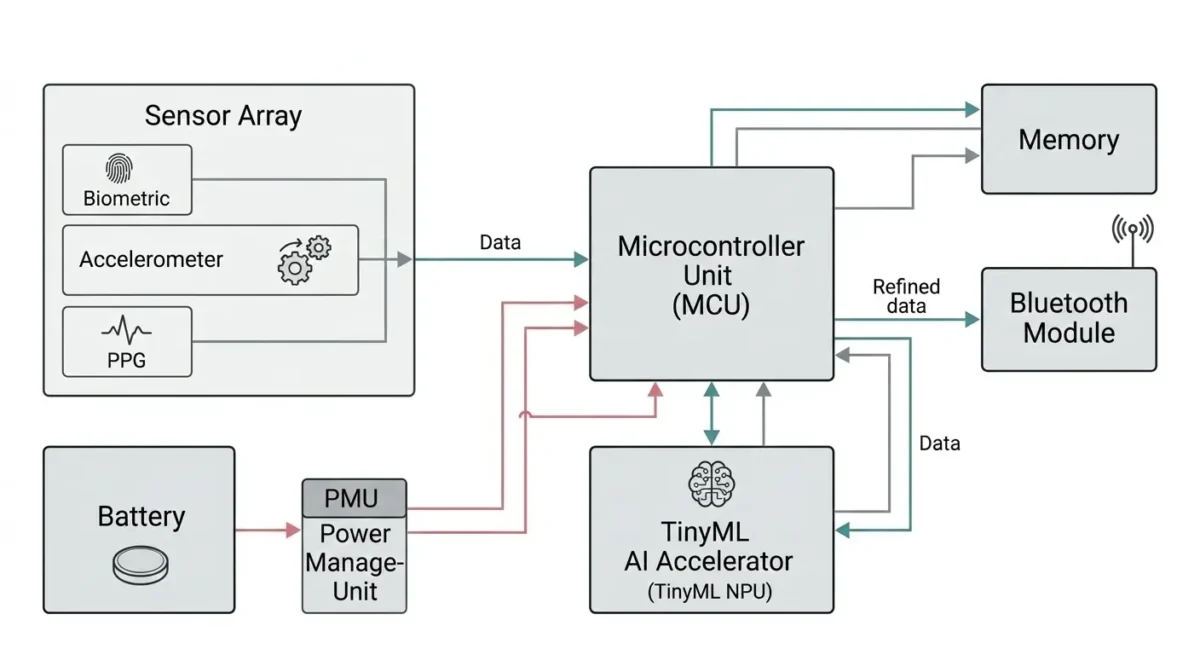
Memory is severely constrained, typically limited to only a few megabytes of on-chip SRAM for volatile data and flash storage for firmware and persistent model storage. Because there is no external DRAM, strict limits are imposed on model size and data buffering, which requires highly optimized and quantized AI models.
In many wearable devices, these compact models fall under the TinyML approach designed for extremely resource-constrained hardware, as explained in our guide on TinyML vs Large AI Models: What Works Best for Edge Devices. This directly affects the sophistication of AI models that can run offline, limiting them to simpler tasks. Connectivity is almost exclusively handled through Bluetooth Low Energy (BLE) to conserve power, enabling communication with a paired smartphone for data synchronization and firmware updates.
Performance Characteristics
The performance characteristics of an AI smart ring are defined by a series of critical tradeoffs driven by its form factor and power budget, making performance bottleneck analysis paramount.
- Power Efficiency (Operations per Joule): This is the paramount metric. The system prioritizes maximizing useful compute per unit of energy consumed. This dictates the use of highly efficient MCUs, specialized accelerators, and aggressive runtime scheduling to minimize active time and maximize deep sleep states, directly impacting battery life.
- Inference Latency: Due to duty-cycling and deep sleep states, the system introduces inherent latency for real-time responsiveness. While critical events might trigger faster wake-ups, continuous, high-frequency, real-time analysis of all data is not feasible without a significant power penalty. Runtime scheduling directly impacts this latency behavior.
- Throughput & Model Complexity: The limited on-chip memory and compute power restrict the size and complexity of AI models. Inference throughput is low compared to smartphone or cloud platforms, typically processing data in batches or at low frequencies. This necessitates highly quantized (4-bit, 8-bit) models, which trade off numerical precision and generalizability for efficiency.
- Thermal Throttling: Even ultra-low-power chips generate heat during sustained inference. In a sealed, small form factor with minimal surface area, thermal throttling becomes a primary constraint on sustained AI performance, often overriding battery life as the immediate limiting factor. The system’s runtime scheduler will actively reduce clock speeds or duty cycle inference to maintain safe operating temperatures.
- Data Fidelity vs. Power: The need to process data locally to conserve power means that complex, high-fidelity AI models requiring higher numerical precision or larger datasets are often offloaded to a smartphone or the cloud. This is a direct “fidelity-for-efficiency” compromise, impacting the depth of offline execution impact.
Real-World Applications
The unique blend of miniaturization, continuous monitoring, and on-device intelligence enables several critical real-world applications for AI smart rings:
- Continuous Health & Wellness Monitoring: Tracking heart rate, heart rate variability (HRV), skin temperature, blood oxygen saturation (SpO2), and activity levels throughout the day and night. The unobtrusive nature facilitates consistent data collection without user intervention, ensuring sustained performance of monitoring over long periods.
- Advanced Sleep Analysis: Accurate detection of sleep stages (awake, REM, light, deep) and sleep disturbances (e.g., apnea events) through passive biometric data, leveraging on-device AI for real-time classification.
- Stress & Recovery Tracking: Deriving stress levels and recovery status from HRV and other physiological markers, providing actionable insights.
- Early Illness Detection: Monitoring subtle changes in baseline physiological parameters (e.g., elevated resting heart rate, skin temperature shifts) that could indicate the onset of illness, often leveraging cloud-based AI for more complex pattern recognition.
- Fitness & Performance Optimization: Providing insights into workout intensity, recovery needs, and overall physical readiness, without requiring a bulky smartwatch.
Limitations
Despite their advanced design, AI smart rings face significant engineering limitations:
- Limited AI Complexity & Generalizability: The reliance on highly quantized models and limited on-chip memory restricts the complexity, nuance, and generalizability of on-device AI. Future models requiring higher numerical precision or more diverse architectures will necessitate cloud offloading.
- Efficiency vs. Flexibility: While specialized AI accelerators offer peak power efficiency for known AI workloads, they create a vendor lock-in and limit the ring’s ability to efficiently execute novel or evolving AI architectures (e.g., Transformers, Spiking Neural Networks) that may emerge as superior for health analytics.
- Latency & Privacy with Cloud Offloading: Offloading complex models to the cloud introduces inherent latency for advanced insights and raises significant privacy concerns. It also creates a dependency on connectivity and often ties advanced features to a subscription model, impacting offline execution capabilities.
- Battery Degradation: The small battery capacity (10-30 mAh) necessitates frequent charge/discharge cycles, leading to a shorter effective lifespan for the battery compared to devices with larger capacities, potentially impacting the device’s overall longevity.
- Robustness to Sensor Noise: The constant contact with skin and motion means raw sensor data is inherently noisy. Limited on-device compute makes sophisticated, real-time noise reduction challenging, potentially impacting the accuracy of on-device insights.
- Firmware Update Vulnerability: Limited Flash memory and often single-MCU architectures make Over-The-Air (OTA) firmware updates critical but inherently risky, with a higher “brick risk” if robust dual-bank firmware storage isn’t implemented.
Why It Matters
AI Smart Rings Explained: devices highlight how AI hardware is evolving toward ultra-low-power edge computing. AI smart rings represent a critical area in pervasive computing and edge AI. They demonstrate the rigorous engineering required to deliver intelligent capabilities within highly constrained environments. Their development advances ultra-low-power SoC design, efficient runtime scheduling, and TinyML model optimization. By enabling continuous, unobtrusive, and intelligent health monitoring, they facilitate a future where AI-driven insights are integrated into daily life, supporting preventative healthcare and personal wellness management. They highlight the ongoing challenge of balancing computational capability with the realities of power, size, and thermal envelopes in next-generation AI systems.
Key Takeaways
- AI smart rings are defined by a “power-first, size-first” engineering philosophy, prioritizing multi-day battery life and miniaturization.
- Their architecture relies on ultra-low-power MCUs, specialized AI accelerators, and extremely limited on-chip memory, necessitating highly optimized and quantized (TinyML) AI models.
- Aggressive runtime scheduling, including deep sleep states and duty-cycled sensor activation, is fundamental to achieving multi-day battery longevity.
- Performance bottlenecks are primarily driven by power budget, memory constraints, and thermal dissipation, leading to tradeoffs in AI model complexity, numerical precision, and real-time responsiveness.
- While enabling continuous, unobtrusive health monitoring, limitations include restricted AI flexibility, reliance on cloud offloading for complex tasks, and inherent latency due to power-saving measures.
8